

Game Informer has learned from a reliable source about some possible exciting new features concerning Microsoft's rumored Origami portable tech device... including the fact that all of the video and screens we've seen of the unit are real (though not final). But there’s one very important detail that no one has touched on yet – Xbox 360 compatibility. So don't wait until March 9 for http://www.origamiproject.com to reveal the system like all those other chumps. Catch all of the juicy information right here, right now.
[Since we broke this story yesterday, OrigamiProject.com has updated their site with even more vagaries than before. The latest flash animation reads:
"hi there
wondering where to find me?"
Then proceeds to display images of a city, forest, mountain, subway, and car. Next, it reads:
"i'm everywhere you are
but never in the way
who am i?
find out 3.9.06..."
So it looks like we've got another week of waiting in store...]
In our previous coverage of Origami, we talked about the system's possible internet, media, and gaming functionality. This has all been verified. In fact, Microsoft supposedly has very high hopes for the system, even going as far as calling on the portable tablet to “replace the laptop.” It is said to be compatible with Windows Vista, but we don’t yet know if Origami will actually use it as an operating system or just use its own.
One of the biggest eye catching moments seen in the Origami video was a running version of what appeared to be Halo. We’ve learned that this isn’t just the PC or Xbox disc slid into the back. Origami will apparently run its very own proprietary gaming software, and a Halo port will most likely be one of the first titles released. But the prototypes we’ve all seen so far seem to have too few buttons to handle a game like this. Microsoft might be considering peripherals for the system like the USB keyboard seen in the video and even a snap on gaming controller shell.
Perhaps the most interesting gaming feature, however, is Origami’s ability to connect to Xbox 360s. Once connected to a 360, presumably through the USB ports, Origami is expected to function as a second screen for compatible games. One example we heard specifically focused on a game in the Ghost Recon Advanced Warfighter vein. While you’re TV is displaying the main game, the Origami could show the first person view of another player to help with tactical planning. Or the Origami screen could display an overhead view of the battlefield from a flying probe. Sports games could use it for play calling in football games or the 24 second shot clock in basketball games. And remember, we’re talking about a touch screen here, so Origami could function as a controller as well as a dedicated screen. These are just a few of the many possibilities unlocked by such a setup. Let’s just hope if this all comes to fruition that Origami’s connectivity doesn’t crap out like Game Boy Advance’s.
Some areas that are still foggy are price range, internal specs, and release date. It will most likely cost at least as much as an Xbox 360, but probably significantly more. Consumers interested the 360 compatibility and exclusive games will have to choose between buying the Origami or purchasing another next gen system like PlayStation 3 or Revolution. That could be a very tough sell for Microsoft as they look to nab a piece of the portable pie. Plus, if they’re try to get developers on board with the second screen feature, Microsoft will have to do a lot of convincing to assure gaming companies that enough gamers will have an Origami to make it worth the extra work. Who knows though, they may just decide to take a huge hit on the price like Sony will have to do for the PlayStation 3.
But these pricing concerns are probably why they’re trying to sell it as an everything machine. If Microsoft markets Origami as something that can replace a PC or laptop, then enough people might buy it for that reason with the gaming features as an added perk.
Thursday’s OrigamiProject.com reveal will most likely give us some more technical information about the system, show professional photos of a “closer to finished” unit than the prototypes we’ve seen so far, and hopefully confirm some of the things we’ve reported. It’s unknown whether they will reveal the 360 gaming functionality or talk much about Origami’s proprietary games. But I guess we’ll all know for sure until March 9.
http://www.gameinformer.com/NR/exeres/33054b43-6f12-473e-b5fe-8184bc35d9ea.htm
Origami
Moderator: Dictators in Training


It's mini tablet pc that microsoft is working on. Supposely the device, Origami, is capable of supporting features like GPS, Bluetooth, 3G cellular technology and Wi-Fi. Bill Gates showed a prototype of it last year at one of the engineering conference. It has a 6 inch screen and cost less than 800 dollars.
Here what Reuters wrote about it:
LONDON (Reuters) - The veil of mystery surrounding Microsoft's secretive Origami portable device lifted just a little on Thursday after the firm updated the project's cryptic Web site, hinting that all would be revealed on March 9.
It may be coincidence, but March 9 is also the launch in Hannover of CeBit, the world's largest annual trade show for the information and telecommunications technology industry.
Information from Microsoft on Origami is sketchy to say the least. Industry reports predict it is the company's long-awaited offering hoping to take a bite out of rival Apple's all-conquering i-Pod.
The only details released so far have been on the Microsoft registered website http://www.origamiproject.com, along with cryptic questions such as "who am I?," "do you know me?," "do you know what I can do?" and "wondering where to find me?" sending rumors flying round Internet Web sites and chatrooms.
Origami is expected to be the size of a paperback book, able to play music, games, connect to the internet and run software.
The viral marketing approach is well employed by Apple, with a feeding frenzy of media attention and rumors generated ahead of each release of the iPod, iBook and iMac products as the often wildly conflicting information is dripped out drop by drop.
LONDON (Reuters) - The veil of mystery surrounding Microsoft's secretive Origami portable device lifted just a little on Thursday after the firm updated the project's cryptic Web site, hinting that all would be revealed on March 9.
It may be coincidence, but March 9 is also the launch in Hannover of CeBit, the world's largest annual trade show for the information and telecommunications technology industry.
Information from Microsoft on Origami is sketchy to say the least. Industry reports predict it is the company's long-awaited offering hoping to take a bite out of rival Apple's all-conquering i-Pod.
The only details released so far have been on the Microsoft registered website http://www.origamiproject.com, along with cryptic questions such as "who am I?," "do you know me?," "do you know what I can do?" and "wondering where to find me?" sending rumors flying round Internet Web sites and chatrooms.
Origami is expected to be the size of a paperback book, able to play music, games, connect to the internet and run software.
The viral marketing approach is well employed by Apple, with a feeding frenzy of media attention and rumors generated ahead of each release of the iPod, iBook and iMac products as the often wildly conflicting information is dripped out drop by drop.



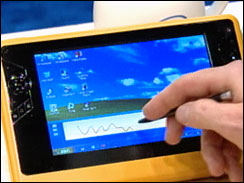
From CBS:
Microsoft hopes the purse-size device it will unveil Thursday at a trade show in Germany will be the next big thing in small computers.
CBS News correspondent John Blackstone got a sneak peak at the device, code-named Origami, from Intel, the company that's making the chips for the new machine.
Brad Graff, Intel's director of marketing, calls the device an ultra-portable computer — somewhere between a cell phone and a laptop. It has a seven-inch screen, can be used as a GPS navigation system, plays movies and music — and, of course, it connects to the Internet.
"You've got a thumb keyboard, so you can send out some e-maail" he says, "and when done you close it up, you are back to where you started."
But in a world where people already carry BlackBerrys, cell phones, iPods and laptops, who needs another device that does many of the same things. Graff says early research turned up a surprise.
"One category we didn't expect is soccer moms," he says. "They would drop of their kids at the game, do some shopping, run an errand and have some dead time. We deployed these devices and we found they loved it. They could get real work done in between things."
But similar "tablet" computers have been tried before and failed. Remember the Apple Newton? You're not alone if you don't. Analysts say the difference now is that there's growing demand from users who want to stay connected and have entertainment at their fingertips.
Early models priced at about $1,000 should be on sale in a few weeks. But the industry is aiming at a $500 mass-market price within a year.
Microsoft hopes the purse-size device it will unveil Thursday at a trade show in Germany will be the next big thing in small computers.
CBS News correspondent John Blackstone got a sneak peak at the device, code-named Origami, from Intel, the company that's making the chips for the new machine.
Brad Graff, Intel's director of marketing, calls the device an ultra-portable computer — somewhere between a cell phone and a laptop. It has a seven-inch screen, can be used as a GPS navigation system, plays movies and music — and, of course, it connects to the Internet.
"You've got a thumb keyboard, so you can send out some e-maail" he says, "and when done you close it up, you are back to where you started."
But in a world where people already carry BlackBerrys, cell phones, iPods and laptops, who needs another device that does many of the same things. Graff says early research turned up a surprise.
"One category we didn't expect is soccer moms," he says. "They would drop of their kids at the game, do some shopping, run an errand and have some dead time. We deployed these devices and we found they loved it. They could get real work done in between things."
But similar "tablet" computers have been tried before and failed. Remember the Apple Newton? You're not alone if you don't. Analysts say the difference now is that there's growing demand from users who want to stay connected and have entertainment at their fingertips.
Early models priced at about $1,000 should be on sale in a few weeks. But the industry is aiming at a $500 mass-market price within a year.

From Reuters:
SEATTLE (Reuters) - Microsoft Corp. unveiled its 'Origami' project Thursday, a paperback-book sized portable computer, which is a hybrid between a laptop PC and a host of mobile devices that the world's biggest software maker hopes will create an entirely new market.
Lighter than two pounds with a seven-inch touch-screen, the new "ultra-mobile" PCs (UMPCs) use microprocessors from Intel Corp. and run a modified version of Microsoft's Windows XP Tablet PC edition.
Samsung Electronics Co. Ltd., Taiwan's Asustek Computer Inc. and China's second largest PC-maker, the Founder Group, are expected to release the first three ultra-mobile PCs, which Microsoft had code-named "Origami" in an elaborate marketing campaign.
South Korea's Samsung's product goes on sale in April.
"This is a single ultra-mobile computer that combines the functionality of many different products," David Steel, the vice president for marketing at Samsung's digital media group, said at the CeBIT technology trade show in Hanover, Germany.
Samsung positions the UMPC as a handheld organizer, an MP3 portable music player, a mobile television receiver, a games device and a notebook PC and believes it will be more successful than the full-sized tablet notebook PC with touch screen, launched four years ago.
"We really believe the difference is now the connectivity. the tablet PC had a certain form factor, but it did not really offer the mobility the new product can do. And along with mobility there is (now) connectivity," Steel said.
The new machines will connect wirelessly to the Internet and carry full-sized hard drives, but they are not intended to replace current PCs.
Microsoft's track record in promoting an alternative PC has produced mixed results. The tablet PC has not yet gained broad appeal despite strong backing from founder Bill Gates.
No U.S. name brand PC makers have signed on to make the new devices, which will have battery life of about three hours, but Microsoft predicted a bright future for the devices.
"We believe that (ultra-mobile PCs) will eventually become as indispensable and ubiquitous as the mobile phone today," Microsoft vice president Bill Mitchell said at CeBIT.
"The Origami project is really our first step toward achieving a big vision," he added.
Intel's European marketing chief Christian Morales said at CeBIT his company and Microsoft were creating a new "category."
Microsoft said it has already held discussions with a number of additional PC and consumer electronics companies to broaden the number of manufacturers.
The new PCs are expected to sell for between $599 to $999, but Microsoft said it is possible to sell one for $500 if the manufacturer selects components carefully.
Microsoft sparked a frenzy by creating a Web site to tout "Origami" with cryptic messages like "do you know me?" and "do you know what I can do?"
This fueled industry speculation that "Origami" would challenge Apple Computer Inc.'s (Research) iPod digital music player or Sony Corp. (Research) PlayStation Portable.
While the product does not compete directly with those popular devices, Microsoft aims to lure gadget fans with ultra-mobile PC models that include features such as global positioning systems for car navigation, digital TV tuners or Web cameras.
"People expect an increasing amount of functionality when they are on the go," said Otto Berkes, general manager at Microsoft's Mobile Platforms Division.
The company acknowledged that battery life is one hurdle for the ultra-mobile PC. Microsoft said it aims to eventually have "all-day" battery life.
"This is the start of a category and there are a number of areas that will require additional investment -- both hardware and software -- to realize the full potential of the category," said Berkes.
Microsoft said future models will run on Windows Vista, the next-generation of its flagship operating system due out in the second-half of 2006.
Tablet PCs, which allows people to use a stylus or digital pen to jot down information instead of typing on a keyboard, have been largely geared toward business users since its introduction in 2002, but the new "ultra-mobile" PC category appears to move the tablet technology into the consumer realm.
This segment of the PC market is not altogether new. Japan's Fujitsu Ltd. and San Francisco-based OQO Inc. already offer a small, portable tablet PC designed for business users.
SEATTLE (Reuters) - Microsoft Corp. unveiled its 'Origami' project Thursday, a paperback-book sized portable computer, which is a hybrid between a laptop PC and a host of mobile devices that the world's biggest software maker hopes will create an entirely new market.
Lighter than two pounds with a seven-inch touch-screen, the new "ultra-mobile" PCs (UMPCs) use microprocessors from Intel Corp. and run a modified version of Microsoft's Windows XP Tablet PC edition.
Samsung Electronics Co. Ltd., Taiwan's Asustek Computer Inc. and China's second largest PC-maker, the Founder Group, are expected to release the first three ultra-mobile PCs, which Microsoft had code-named "Origami" in an elaborate marketing campaign.
South Korea's Samsung's product goes on sale in April.
"This is a single ultra-mobile computer that combines the functionality of many different products," David Steel, the vice president for marketing at Samsung's digital media group, said at the CeBIT technology trade show in Hanover, Germany.
Samsung positions the UMPC as a handheld organizer, an MP3 portable music player, a mobile television receiver, a games device and a notebook PC and believes it will be more successful than the full-sized tablet notebook PC with touch screen, launched four years ago.
"We really believe the difference is now the connectivity. the tablet PC had a certain form factor, but it did not really offer the mobility the new product can do. And along with mobility there is (now) connectivity," Steel said.
The new machines will connect wirelessly to the Internet and carry full-sized hard drives, but they are not intended to replace current PCs.
Microsoft's track record in promoting an alternative PC has produced mixed results. The tablet PC has not yet gained broad appeal despite strong backing from founder Bill Gates.
No U.S. name brand PC makers have signed on to make the new devices, which will have battery life of about three hours, but Microsoft predicted a bright future for the devices.
"We believe that (ultra-mobile PCs) will eventually become as indispensable and ubiquitous as the mobile phone today," Microsoft vice president Bill Mitchell said at CeBIT.
"The Origami project is really our first step toward achieving a big vision," he added.
Intel's European marketing chief Christian Morales said at CeBIT his company and Microsoft were creating a new "category."
Microsoft said it has already held discussions with a number of additional PC and consumer electronics companies to broaden the number of manufacturers.
The new PCs are expected to sell for between $599 to $999, but Microsoft said it is possible to sell one for $500 if the manufacturer selects components carefully.
Microsoft sparked a frenzy by creating a Web site to tout "Origami" with cryptic messages like "do you know me?" and "do you know what I can do?"
This fueled industry speculation that "Origami" would challenge Apple Computer Inc.'s (Research) iPod digital music player or Sony Corp. (Research) PlayStation Portable.
While the product does not compete directly with those popular devices, Microsoft aims to lure gadget fans with ultra-mobile PC models that include features such as global positioning systems for car navigation, digital TV tuners or Web cameras.
"People expect an increasing amount of functionality when they are on the go," said Otto Berkes, general manager at Microsoft's Mobile Platforms Division.
The company acknowledged that battery life is one hurdle for the ultra-mobile PC. Microsoft said it aims to eventually have "all-day" battery life.
"This is the start of a category and there are a number of areas that will require additional investment -- both hardware and software -- to realize the full potential of the category," said Berkes.
Microsoft said future models will run on Windows Vista, the next-generation of its flagship operating system due out in the second-half of 2006.
Tablet PCs, which allows people to use a stylus or digital pen to jot down information instead of typing on a keyboard, have been largely geared toward business users since its introduction in 2002, but the new "ultra-mobile" PC category appears to move the tablet technology into the consumer realm.
This segment of the PC market is not altogether new. Japan's Fujitsu Ltd. and San Francisco-based OQO Inc. already offer a small, portable tablet PC designed for business users.
I heard today that the creator split his ferrari (or whatever car he was driving) in half and they put this project on the back burner. Anyone else hear anything like this?
Also, Halo 3 out early 07 and Halo the movie out late 07. Microsoft honestly does not see PS3 coming out before 07. Rumors here say that the blueray technology runs around 1600 bucks and that Sony would have to charge an insane amount for the PS3 in order to not go broke with their projected 6 million units by launch.
Like I said, though..it's only rumors...
edit sorry got my blues mixed up
Also, Halo 3 out early 07 and Halo the movie out late 07. Microsoft honestly does not see PS3 coming out before 07. Rumors here say that the blueray technology runs around 1600 bucks and that Sony would have to charge an insane amount for the PS3 in order to not go broke with their projected 6 million units by launch.
Like I said, though..it's only rumors...
edit sorry got my blues mixed up
Last edited by Ouchyfish on Wed Mar 22, 2006 12:57 pm, edited 1 time in total.
Lyion wrote:If Hillary wins Texas and Ohio, she'll win the nomination.
Tossica wrote:Seriously, there is NO WAY Sony is going to put HD-DVD out of the game.
-
Jay
That's what I am saying, Taxx, Microsoft is betting against that..I wouldn't be surprised since that is becoming an annoying trend with everything in that industry anymore.
Lyion wrote:If Hillary wins Texas and Ohio, she'll win the nomination.
Tossica wrote:Seriously, there is NO WAY Sony is going to put HD-DVD out of the game.
Erodalak wrote:Oh, what's blueray?
Blu-Ray disc is Sony's version of the successor to dvd.
From Blu-ray.com:
Blu-ray, also known as Blu-ray Disc (BD), is the name of a next-generation optical disc format jointly developed by the Blu-ray Disc Association (BDA), a group of the world's leading consumer electronics, personal computer and media manufacturers (including Apple, Dell, Hitachi, HP, JVC, LG, Mitsubishi, Panasonic, Pioneer, Philips, Samsung, Sharp, Sony, TDK and Thomson). The format was developed to enable recording, rewriting and playback of high-definition video (HD), as well as storing large amounts of data. The format offers more than five times the storage capacity of traditional DVDs and can hold up to 25GB on a single-layer disc and 50GB on a dual-layer disc. This extra capacity combined with the use of advanced video and audio codecs will offer consumers an unprecedented HD experience.
While current optical disc technologies such as DVD, DVD±R, DVD±RW, and DVD-RAM rely on a red laser to read and write data, the new format uses a blue-violet laser instead, hence the name Blu-ray. Despite the different type of lasers used, Blu-ray products can easily be made backwards compatible with CDs and DVDs through the use of a BD/DVD/CD compatible optical pickup unit. The benefit of using a blue-violet laser (405nm) is that it has a shorter wavelength than a red laser (650nm), which makes it possible to focus the laser spot with even greater precision. This allows data to be packed more tightly and stored in less space, so it's possible to fit more data on the disc even though it's the same size as a CD/DVD. This together with the change of numerical aperture to 0.85 is what enables Blu-ray Discs to hold 25GB/50GB.